Grieving a Genocide
July 2025
What do we do with our grief, as we watch a genocide unfold? I only know that grief must be an action.
I think about August 4th approaching, the second of my father’s birthdays after his death, but this year I’m not with my mother and sister, visiting the funeral home and unsettling the quiet of its marble with raucous laughter at my mother’s stories. I am crying at my altar. Palestinians are being starved, as I type, as I shuffle around, as I work, as I make tea, as I play with my son, as I bathe, and eat, and run, and do all the tedious but meaningful things they struggle to do or outright can’t.
I wrap myself in my father’s keffiyeh. The picture on my altar frames him in front of his paintings and his prized tent heater, the crescent moon and star floating at its top. He filled that thing with god-knows-what paperwork and bits, never having needed to light it for warmth. I hugged him the last Christmas I saw him, as he cried for Palestine, and told him that I knew Palestine would be free. That I’ve seen change coming. I wish he could have seen it too, but he couldn’t wait to return to the land, hand in hand with his grandfather, so he left.
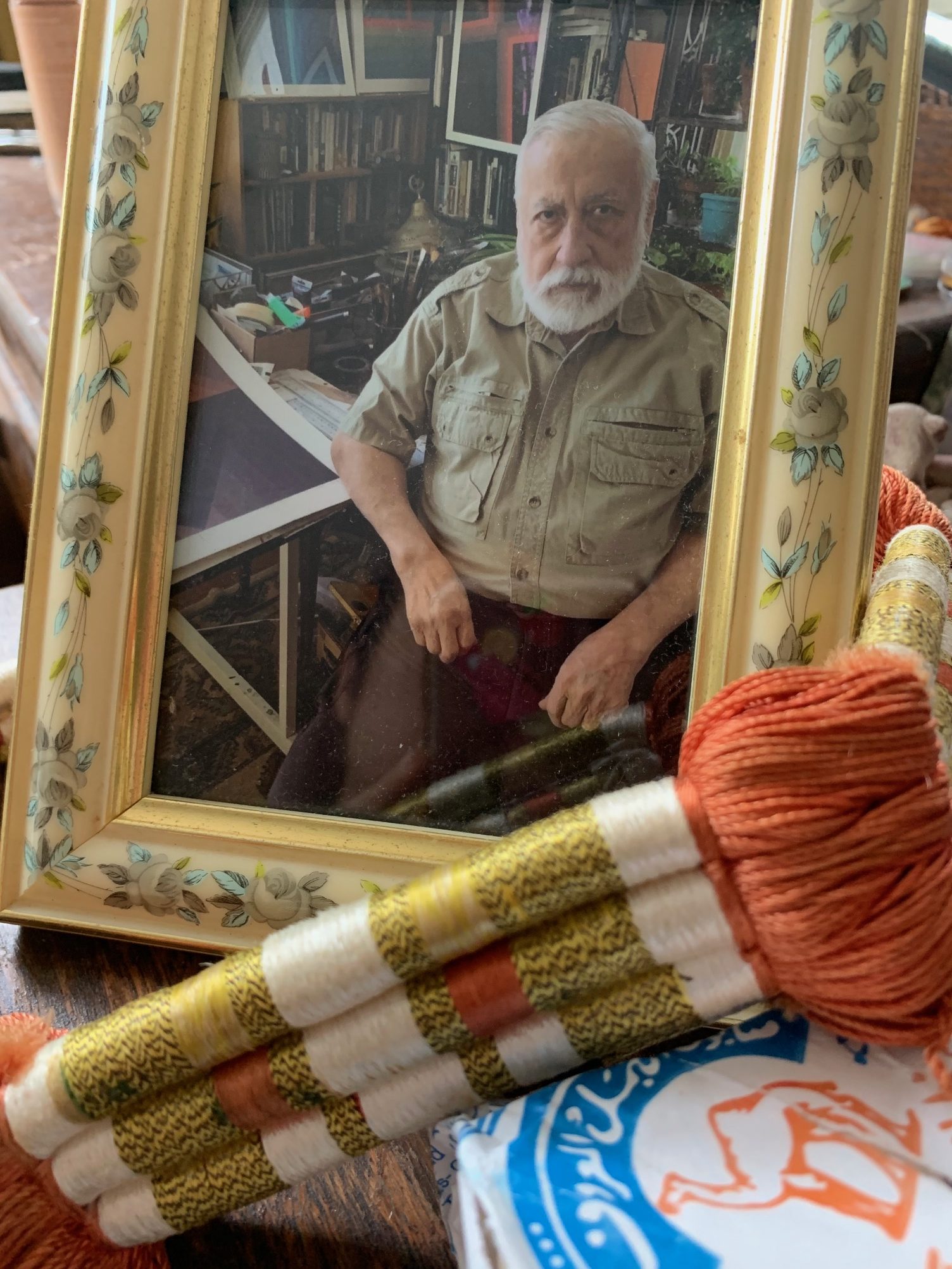
I don’t want to veer into romanticizing my father. His insistence on honesty wouldn’t allow it (even when he fibbed), and to deny someone their worse qualities is to deny them full humanity. Palestine is not about him or me, but he is my starting point, the first place I met my ancestors.
Palestine is for Palestinians, still feeding the land with their blood and sumud. Palestine will be free, but the cost is unbearable and avoidable. I am often on the verge of tears in polite conversation or, I would be, but I always end up twisting the conversation so that it is no longer polite, or no longer a conversation- whichever comes first.
What should I do with my grief? I only know that grief should be an action.
I move between witnessing and doing, even when both feel useless, even when I am told they are. I think about making grape leaves for my father’s birthday. I remind myself that grief is powerful. It is July 2025. The starvation of Palestine is a tool of colonization, a result of Israel’s five-month blockade on food, fuel, water and humanitarian supplies, in addition to the historical restriction and control of necessities. Journalist Anas al-Sharif breaks down as he is reporting; he has witnessed a woman fall to the ground in hunger and she is only one of hundreds of thousands. I feel useless, it’s true. I don’t need anyone with ill will to tell me as much. But I also know, from the deepest parts of ourselves, we stay the course.
Steadfastness I understand. It is among all the entities that constitute what I colloquially refer to as ‘myself’. Palestine will be free. This is not a wish but something already coming in to being, the evidence of which is all around us and within us. We never waiver from this position. Ask any Palestinian, any displaced descendant, any true accomplice. We do not waiver. We are too connected for that. All of us magnificent oracles, working toward the shortest possible distance to our prophecy. This is what we do with our grief. This is grief as action.
Of Palestine
February 2024
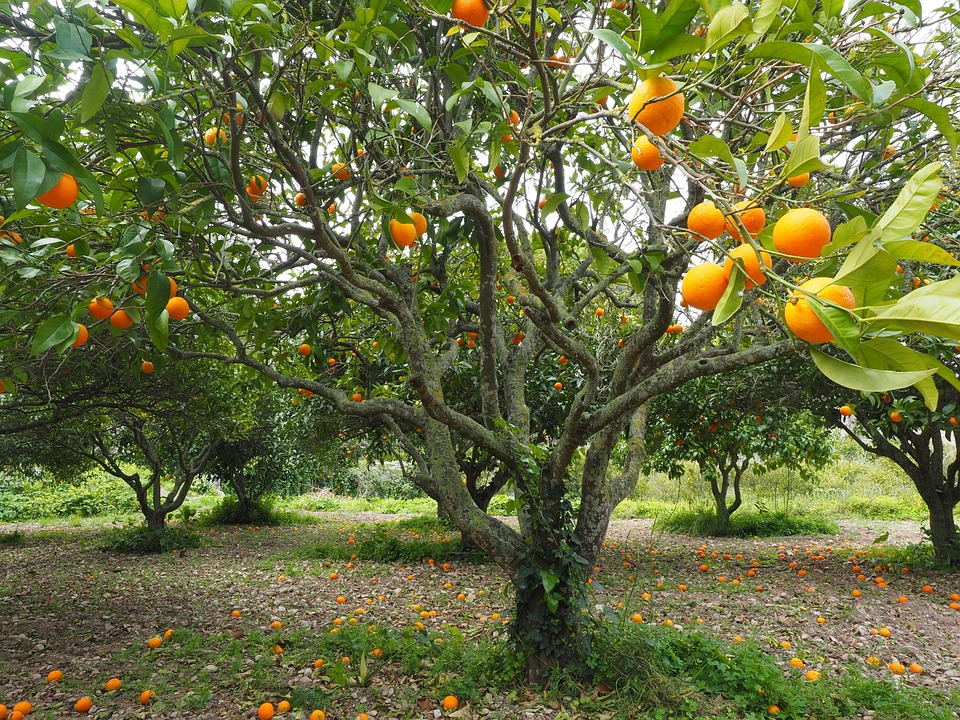
I’ve known for a while now why my father mourned the orange groves. A distanced knowing, the way you feel when you’ve read something somewhere, on a face or in a text. Now I know, as in I feel it, and I’m ashamed it took me so long to conjure up the pulse of everyday life saturated with sun and juice. It could be an aesthetic movement easily, “tomato girl summer”, but the genocide mucks it up. It’s not clean enough to wear, hardly the makings of a fantasy except for those who’ve lost it.
I think about how papa repeats the same stories over and over. He hung out with the Black Panthers in Chicago, in the 70s. Didn’t I get it? It’s not just his story- it was a gift to us. I remind myself to hang the Ten-Point Program on our wall. I think about the Rainbow Coalition and I let a scream linger behind my clenched jaw. I run with more purpose than I have in a while. I can barely breathe but I run with Nina Simone in my ears laughing through her anger, rousing the audience to preach back “too slow”. “Desegregation.” “Too slow.” “Mass participation.” “Too slow.” “Reunification.” “Too slow.”
It is too late already. I am going for a lovely run in an idyllic park and my limbs are tingling with lack of oxygen, or distress, or both, and I am in mourning. In northern Gaza people are starving. In Rafah people wait to be massacred like sitting ducks, because this was the safe zone, this was where they were told to go, but of course, there hasn’t been a safe zone for a very long time. I’ve seen children covered in dust and debris from bombings, a kid saying so straightforwardly that his parents were shot in front of him. I’ve seen a toddler’s insides pouring from their tiny body. I’ve seen a mother, face down, still holding hands with her child after being shot by a sniper. I’ve seen men stripped, bound, and the mass graves that proliferate. And this is what we catch between media blackouts and well worn distractions.
Somehow, I still wonder if I should let people know about my great-grandfather, as if I delegitimize myself by my ancestry. It’s a horrible thought and my partner rails against it for me. Everything in my being pushes against it too, but somehow all my attempts to be critical of objectivity falter because I’m afraid that once I mention my ancestors, it’s the only thing they’ll see. Not the multitude ways of knowing I’ve embraced, not the history I’ve had to pull together because it was spread far and wide like rubble, not the grappling I’ve had to do with myself to unlearn dominant narratives, not the ways that I am still constantly reading, listening, in a desperate attempt to find hope. They’ll see someone who is affected only because of their bloodline, not their humanity. I think about a woman in the Congo’s eyes as she tells of the rapes she suffered with the bodies of her husband and children around her. I scratch away at obfuscation and try to not let anyone confuse it with poetry.
I arrive at a work meeting in a sweatshirt, hair damp and stringy from running. A run is the least I can ask for and professionalism seems a bit trite set against a real-time massacre. After all, I’m just floating about, my head disconnected from the rest of my body. It’s the computer screen and the lack of oxygen. I was sick this weekend and fainted for the first time in my life, and then for the second. I was terrified of the unknown where I normally delight in it. Still, I’m glad to experience my body saving my consciousness the trouble.
I let my head wander back to my body. I stretch dough and wonder at the new spell I’ve acquired, learning to make pita bread at 36. I think about my own toddler, so safe in this world that any hint of danger feels like it will shatter me. I think about my self-indulgence. I think about writing as a form of mourning. I think about Palestine. I mourn the orange groves, the olive trees, and the people recording their own final words. I feel sick. I think about Palestine. I think about Palestine.
 Anais Carlton-Parada